

In commodity trading companies, business–finance integration is not a new concept. However, truly successful cases that run stably and continuously generate management value are still rare.
The problem is not that companies ignore financial management. Nor does a lack of systems cause it.The real issue is that trading activities are highly complex and constantly evolving. For a long time, these activities have been difficult to convert into a continuous set of business facts that finance can understand and use. This problem appears in two main aspects:
1).Misalignment between business and finance
Dynamic nature of trading:
Commodity trading is not a one-time static event. It is a dynamic process that runs through contract signing, pricing, execution, and settlement.Prices fluctuate continuously during the pricing period.Quantities and quality often become confirmed only after delivery.Various costs also arise at different stages. At the same time, physical trades and paper trades coexist. Together they affect trading profit and loss as well as capital utilization.
Characteristics of financial management:
In contrast, financial management relies more on static results. Examples include invoiced revenue, confirmed costs, and actual cash receipts and payments.
Consequences of misalignment:
When a trade is still “in progress,” the business side may already have committed funds, taken on risk, and effectively locked in profit or loss. However, this information does not automatically enter the financial view. As a result, business and finance become misaligned in both timing and facts. The business side considers that it has established the trade and generated results. Finance only sees the final accounting data after the trade is completed.
2).Amplification effect of multiple parallel systems
The use of multiple systems further magnifies this misalignment. Financial systems focus on accounting. Treasury systems focus on cash receipts and payments. Several systems and sometimes offline spreadsheets scatter business information. As a result, trading facts constantly fragment. At month-end, teams require large amounts of manual consolidation.
When trading volume and complexity increase, coordination between business and finance quickly breaks down. This directly affects decision-making efficiency and business development.
Therefore, for commodity trading companies, business–finance integration must be rebuilt around the trade itself. Systems need to manage contracts, pricing, execution, and settlement in a unified way. Cash management, settlement, and accounting should all operate based on the same trading facts. This is exactly the core value of Fusion CTRM.
As the central hub of trading facts, Fusion CTRM provides a clear and practical path for business–finance integration:
- Before the trade: use trade-driven cash management so that funds truly follow the rhythm of the business.
- During the trade: use settlement as the central link so that complex business outcomes continuously accumulate into accounting-ready data.
- After the trade: use month-end closing and accounting rules as a structured closing mechanism so that business results can steadily enter the financial system.

The following sections will focus on these three stages. They explain how Fusion builds a practical and sustainable model for business–finance integration in trading companies.
1. Before the trade: Trade-driven cash management so funds follow the business
1.1 Pain points
In commodity trading, financial pressure rarely comes from a simple lack of cash on the books.The real issue lies in the large amount of capital that trades have already committed but have not yet generated accounting entries.
This type of capital commitment is usually large in amount, frequent, long in duration, and constantly changing.
Typical situations include:
- Prepayments under signed contracts that have not yet been paid,
- Physical cargo in transit with final payments still outstanding,
- Margin requirements for paper positions that change with market movements,
- Various costs that have occurred but have not yet been settled or invoiced.
These capital commitments are real from a business perspective. However, they are difficult to map accurately to specific trades and settlement schedules. In traditional financial systems they are often invisible, unpredictable, and difficult to quantify. Finance can only see current account balances and completed payments or receipts. It cannot easily answer the question most important to management:
How much real funding pressure will the company face in the near future?
As a result, finance can only react after funding pressure appears. At the same time, business teams cannot clearly see real funding constraints when advancing trades. Cash management and trading operations remain disconnected for a long time.
1.2 Solution
At the pre-trade stage, the core value of Fusion lies in bringing cash management back to the center of trading activities.
Through the cash management module, the system does more than record completed cash flows. It also links cash planning directly to contract terms, trade execution status, and settlement arrangements. In this way, future capital commitments are presented in a structured and systematic form.
Cash planning framework
The system uses rolling management across multiple time dimensions, such as daily plans and monthly plans. The following elements are included in a unified framework:
- Actual receipts and payments that have already occurred, together with account balances,
- Capital commitments generated by ongoing trades,
- Future funding needs derived from contract terms and settlement milestones.
Daily planning
At the daily planning level,the system shows historical cash movements and the current status for each day. It combines this information with trade and settlement schedules to produce short-term funding forecasts. This helps companies continuously track deviations between planned and actual cash execution.
Monthly planning
At the monthly level and over longer time horizons,the system supports cash budgeting and overall planning. Cash arrangements therefore become a dynamic management tool that closely matches the execution rhythm of trading activities.
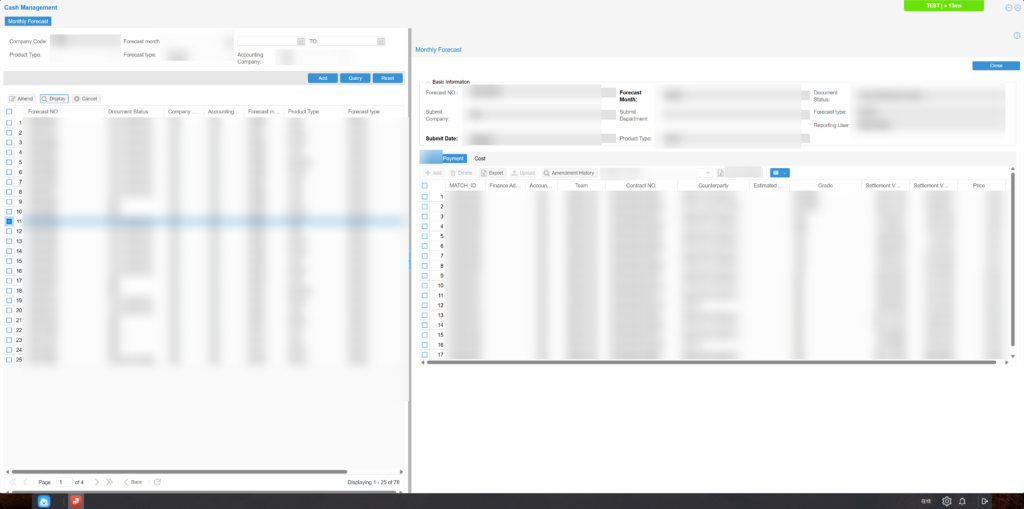
Rolling cash management benefits
Through rolling cash management across multiple time horizons, companies can ensure the continuous progress of business activities while significantly improving the accuracy and forward-looking capability of cash management.
1.3 Case
A large energy trading company typically faces multiple funding milestones in a single cross-regional crude oil trade. These include prepayments, staged payments, and final settlement payments.
Before adopting Fusion
The company’s cash planning mainly remained at the monthly budgeting level. Business teams could not easily see potential payment concentration within the next one or two weeks. As settlement dates approached, the company frequently arranged temporary fund transfers.
After implementing Fusion
The company directly linked cash plans to trading contracts and settlement milestones. The system generates rolling daily projections of future capital commitments. This allows finance to participate in cash scheduling in advance, ensuring both funding security and stable business operations.
After implementation
The company’s visibility into capital commitments over the next two weeks improved by approximately two to three times. The number of temporary fund transfers near settlement dates decreased by about 40%.
Cash management has shifted from reactive correction to an integral part of trading decisions. Capital commitments are now clearly visible: which trades created them, how long they will last, and whether they will create concentrated pressure or future cash inflows.
2. During the trade: Use settlement as the core link so business results become accounting data
If cash management ensures that trades can continue smoothly, settlement management solves another problem. It ensures that business results are accurately and continuously converted into financial results.
2.1 Pain points
In commodity trading, settlement runs through the entire trade execution process. The final result of a trade is usually determined by several factors:
- At the physical trade level, this includes prepayments, partial cargo payments, final payments, and adjustments for quantity and quality differences.
- At the cost level, this includes freight, demurrage, insurance, port charges, inspection fees, and other costs. These expenses often need to be allocated across different cargo batches or contracts.
- At the derivatives level, settlement also includes profit and loss from paper trades and margin payments or refunds.
- At the same time, multiple settlement methods exist. Examples include telegraphic transfer, letters of credit, back-to-back letters of credit, and documentary collections.
The main problem is not whether these settlement items can be calculated. The real issue is that different systems, spreadsheets, and individual judgments scatter them.There is no unified structure that links all results back to the same trade.
As a result:
- Cost allocation depends heavily on individual experience.
- Physical and paper trade settlements are calculated under different standards.
- Even after repeated reconciliations, finance may still struggle to confirm the completeness and accuracy of settlement data.
Settlement gradually becomes a process of manual compilation and repeated corrections after the fact.
2.2 Solution
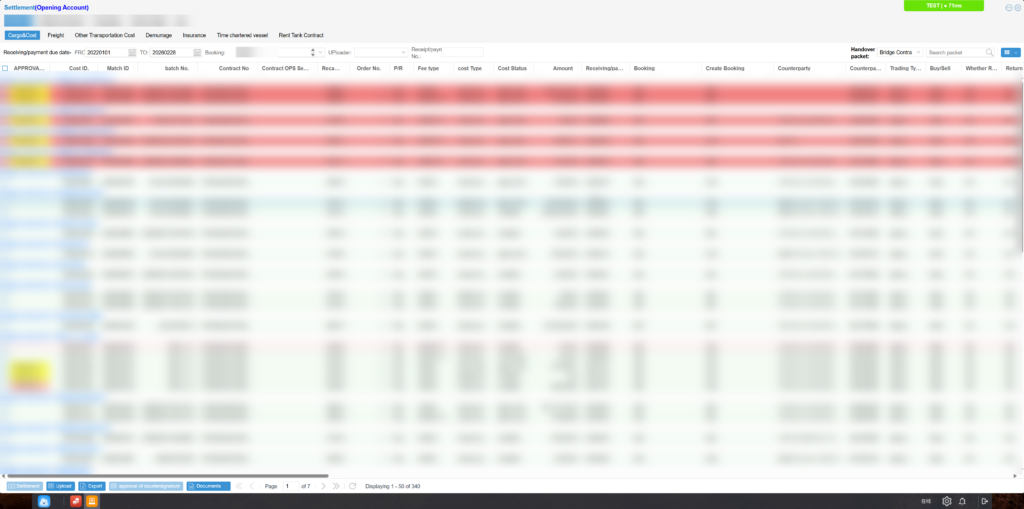
During the trade stage, Fusion transforms settlement. It is no longer an isolated step performed after the trade. Instead, it becomes a natural extension of the trading process. Settlement results are generated continuously along the trade execution path.
For physical trades, Fusion first expresses key trading elements in a structured way at the trade level.These elements include contract terms, pricing formulas, payment conditions, and credit terms. They serve as the basic rules for settlement calculations.
During trade execution, payments and costs generated by logistics, transportation, and storage are captured immediately. They are processed in a structured form and automatically linked to the corresponding trade structure.
Cost allocation objects, allocation methods, and calculation logic are defined in advance through rules.The system executes them semi-automatically. This greatly reduces reliance on manual judgment.
Under this mechanism, settlement can cover:
- Multiple types of physical trade transactions
- Cargo payments and cost settlements across the entire trade lifecycle
- Automatic allocation and calculation of costs across multiple parties and nodes
- Batch processing for high-frequency settlements such as freight payments
- Structured management of key elements such as currencies, tax rates, exchange rates, and settlement methods
This structure keeps business operations flexible while ensuring consistent financial standards.
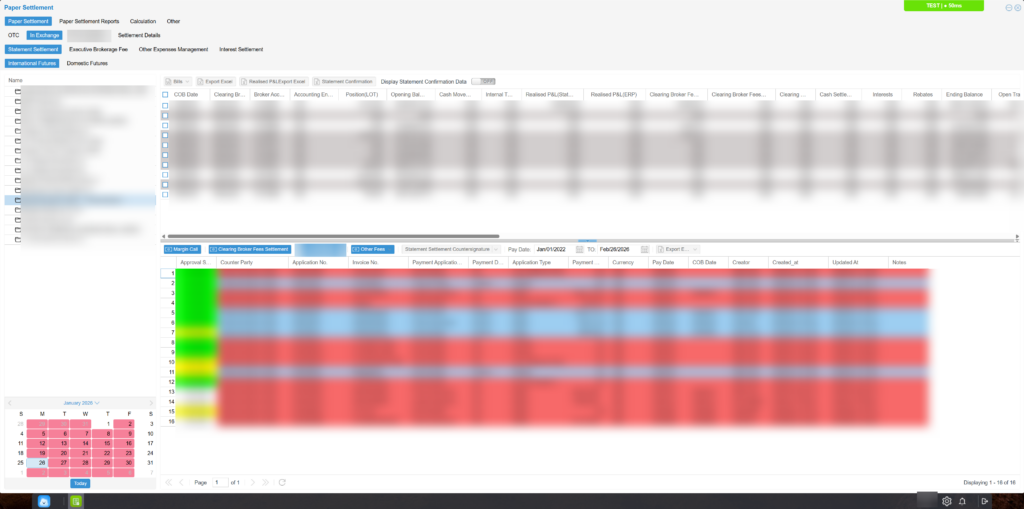
On this basis, Fusion also integrates paper trades into the same settlement framework. It supports structured management of realized and unrealized P&L, margins, interest, commissions, and related fees from derivatives trading.
Through statement parsing and system integration, the platform significantly reduces manual data entry and consolidation work.
Paper trade settlement results can also be linked to the corresponding physical trades and risk strategies.This creates a complete and traceable settlement chain for each trade.
By using the trade settlement chain as the main structure, Fusion brings both physical and paper trade settlement flows into a unified framework. Combined with approval workflows and document management such as invoices, the system effectively solves common settlement problems: fragmented information, disconnected processes, and low efficiency.
As a result, complex business outcomes are continuously consolidated into a consistent set of accounting-ready data.
2.3 Case
A transaction at an international oil products trading company often involves multiple transportation segments and several storage locations.Different parties incur related costs at different times.
Under the traditional approach, business teams manually collected and allocated these costs. Finance had to repeatedly check cost allocations at month-end. The settlement process depended heavily on personal experience.
After implementing Fusion, the company modeled cost allocation rules in advance. When a cost occurs, the system automatically assigns it to the relevant trade structure.
Finance can trace the settlement results it sees directly back to specific business activities.Settlement has shifted from manual explanation to rule-driven processing.
After implementation, the number of settlement adjustments caused by cost allocation issues decreased by about 50%. Overall settlement efficiency improved significantly.
At the same time, in an environment where physical and paper trades operate together, Fusion connects the data flows. Teams can clearly link profit and loss from paper trades to physical trades and risk strategies.This ensures a unified data standard.
Implementation results show that manual work for organizing paper trade settlement data dropped by about 50%. The alignment efficiency between physical and paper trade settlements improved by about 40%. Inconsistent settlement standards also greatly reduced month-end adjustments.
Settlement is no longer a process of financial reprocessing. It becomes the natural outcome of trading rules in operation.
3. After the trade: Use month-end closing and accounting rules as the consolidation mechanism so business results are truly recorded
Although settlement can now generate accounting-ready data along trading rules, the tension between business and finance does not disappear. Instead, it often concentrates in the month-end closing and accounting stage. A proper consolidation mechanism is needed so that business results can enter the financial system in a stable and consistent way.
3.1 Pain points
During month-end closing, conflicts between business and finance become especially visible in commodity trading companies. Common situations include the following:
The business team believes it has completed a trade and generated results.However, finance cannot directly record it in the books.Different departments may interpret the scope of data, the timing of recognition, and the allocation of costs differently. As a result, month-end closing turns into a highly manual process that requires repeated communication and adjustments.
The root cause is not the complexity of accounting standards. The real issue is that business data is not prepared in a structured way according to accounting logic.
Rules do not clearly connect trade execution, settlement processing, and accounting recognition.Because of this gap, many issues accumulate and surface during month-end closing. This significantly increases friction between business and finance.
3.2 Solution
At the post-trade stage, the core value of Fusion lies in creating a systematic path from business facts to accounting results. This is achieved through month-end management and predefined accounting rules.
Through the month-end management function, the system introduces unified closing rules and process controls. It clearly defines:
- Trade and settlement data eligible for inclusion in the current accounting period
- Items that require accrual treatment
- Transactions that should be recognized in a later period
The system automatically determines and locks the scope of data for the accounting period. This includes boundaries for revenue and cost recognition. The logic follows financial accounting rules. Once confirmed, the data is automatically transferred to the financial system. This greatly reduces the amount of manual reconciliation required by finance during month-end closing.

Through accounting period management, accrual management, and unified management of settlement-related data, month-end closing no longer depends on frequent cross-department coordination. Instead, it becomes a rule-based centralized process. This shortens the closing cycle and reduces the reconciliation workload for finance.
3.3 Case
In a company with high-frequency physical trading, the finance team previously spent significant effort every month determining the accounting scope of cross-period trades. The month-end closing process depended heavily on personal experience.
After implementing Fusion, the system automatically locks data boundaries during month-end closing.The system directly transmits the confirmed results to the financial system.The system directly transmits the confirmed results to the financial system.Month-end closing shifts from intensive manual reconciliation to a standardized and auditable process.
After implementation, the company shortened its month-end closing cycle by about 30%. The manual workload required to determine the accounting scope of cross-period trades was reduced by about 50%.
In addition, to further automate the accounting process, the company moved certain accounting rules forward and embedded them into the trade settlement workflow in Fusion. One example is sales revenue recognition.
In the past, revenue recognition varied depending on the transaction structure. The responsible entity and recognition method could differ from case to case. Finance therefore had to repeatedly review the business background during the accounting stage. The process relied on manual judgment and communication.
Now, during system configuration, the company models the mapping between business scenarios and accounting types. During trade execution, business users assign the relevant scenario and accounting type to each trade.
Based on these trade facts, the system generates structured revenue recognition results. This greatly simplifies the finance team’s later processes, such as revenue offsetting and automated journal posting.
Implementation results show that in revenue recognition processing for these trades, reliance on manual explanations and repeated confirmations during the accounting stage dropped by about 40%. This also created stable conditions for further automation of accounting entries.
This customized approach does not change the role of the financial accounting system. However, it significantly reduces the reliance on manual explanations during the accounting stage. It also demonstrates that moving rules forward at the trade level can create favorable conditions for later accounting automation.
4. Conclusion
Looking across the three stages—before the trade, during the trade, and after the trade—business–finance integration in commodity trading companies cannot be achieved simply by adding more reconciliations or strengthening financial control.
The key lies in whether the trade itself is managed as a continuous and unified object.
When trades fragment across different systems and stages, finance can only piece together results after the fact.Business teams also struggle to understand the logic behind funding, settlement, and accounting. In this situation, business–finance integration becomes superficial.
However, when funding, contracts, pricing, execution, settlement, and accounting all develop continuously around the same trade, several outcomes occur naturally. Funding schedules, settlement results, and accounting recognition follow the trade process and generate in a consistent way.
Under this structure, business–finance integration does more than improve efficiency. It represents a shift in management practice:
- Finance moves from being a post-event recorder to a participant in risk and profit management based on trade facts.
- Business teams gain a clear understanding of profit structures and cost sources.
- Management obtains a unified and interpretable operational view.
- At the same time, a complete and traceable trade settlement chain provides a strong foundation for audit, internal control, and compliance.
This is where Fusion delivers its value. It does not simply build another bridge between business and finance. Instead, it places the trade at the center and naturally integrates funding, settlement, and accounting into a single operational framework. In this way, business–finance integration moves from concept to sustainable practice.
Note:
The month-end closing date serves as a marker that determines when business activities and financial entries are recorded or carried forward. After the closing date, the system processes all subsequent transactions in the next accounting period, even if the actual business activity occurred within the current month.
Fusion Solution Series Article Navigation
Fusion: Smart Solutions for Physical Commodity Trading
Overcoming Bulk Energy Maritime Logistics Challenges
Tackling Energy Inventory Challenges with Fusion
Fusion Derivatives Trading: Systematic & Tailored Practices
Fusion Solution: Commodity Trading Market Risk Management
Fusion Applied: Credit Risk Management for Commodity Trading